SEO for Renovation Companies: How We Built TRT’s Full Home Renovation Cluster
How ANDER connected keyword mapping, local service pages, renovation projects, and homeowner stories for The Renovation Team in Auckland.
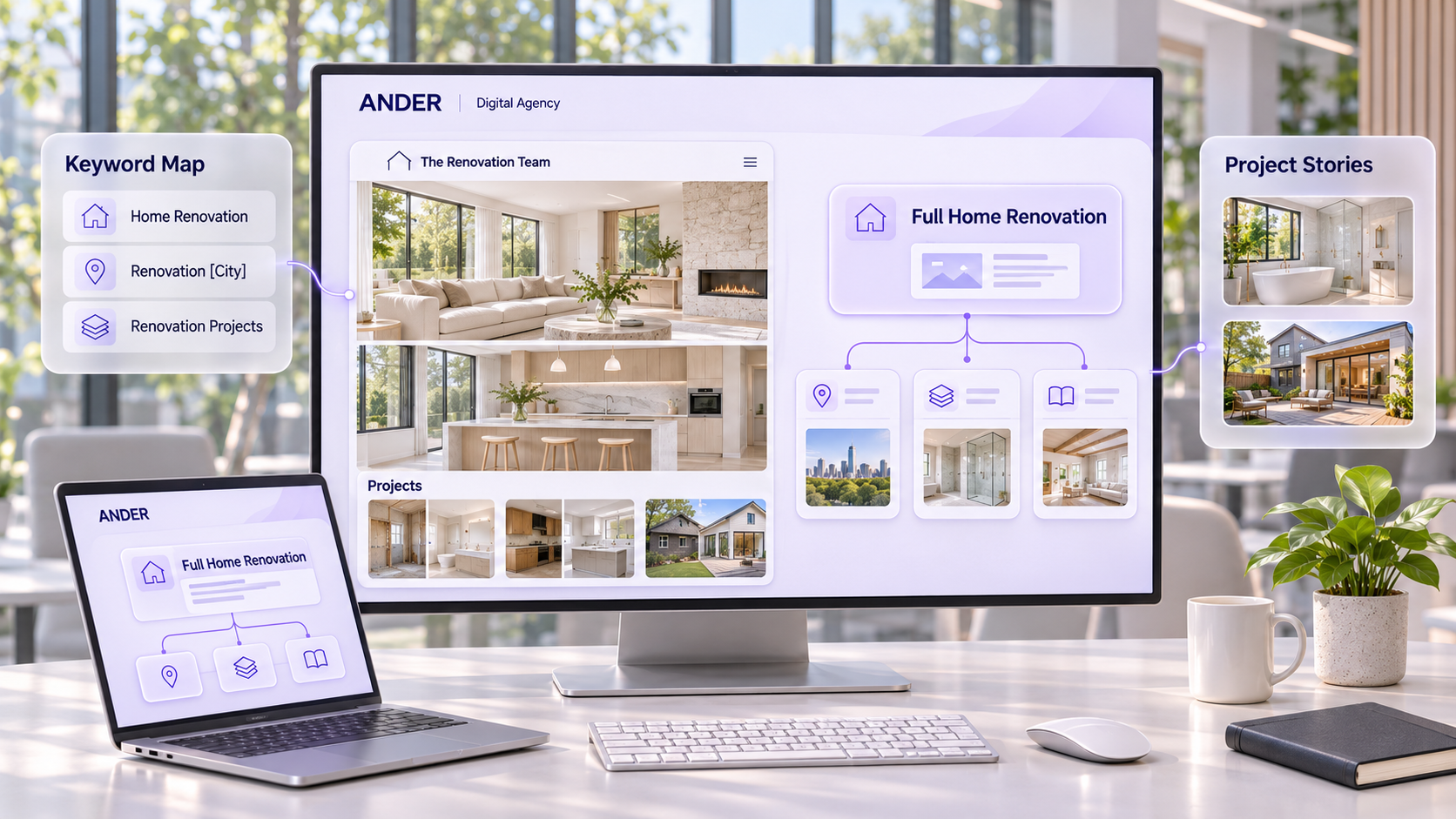
A homeowner searching for a renovation company has different questions from someone deciding whether to remodel or move. Another homeowner may already know what they want and simply need to see a project similar to theirs.
Those differences shaped our approach to SEO for renovation companies when we developed the Full Home Renovation content cluster for The Renovation Team, an Auckland renovation business.
We connected a commercial service page with location pages, individual project pages, and detailed Project Stories. Each format had a specific job: explain the service, establish local relevance, demonstrate completed work, or explore a homeowner’s decision.
This article focuses on that keyword and content architecture: how we gave related topics distinct page roles and connected them through internal links. It is one example of the work behind our SEO strategy and ongoing SEO services.
Start with the renovation service the business wants to grow
The commercial focus was full home renovation: projects involving several connected parts of a property, often with layout changes and coordinated work across multiple rooms.
That gave the cluster a clear center. TRT’s Full Home Renovations in Auckland page explains the service and helps homeowners take the next step toward discussing their project.
The supporting content needed to make that offer more tangible.
A completed kitchen can show craftsmanship. A documented renovation can also explain why the layout changed, how different rooms were considered together, and what the owners wanted from the home. Those details help a reader understand what a larger renovation might involve.
Our starting point was therefore a business priority supported by relevant examples. From there, we could organize the questions, locations, and projects that belonged around it.
Turn related keywords into a page map
A useful keyword map connects a search topic with an appropriate page and a clear reason for that page to exist.
For TRT, the published structure illustrates four different kinds of search intent:
| Representative query family | Page role | What the reader needs |
|---|---|---|
| Full home renovations Auckland; full house renovation Auckland | Main service page | Understand the offer, process, scope, and route to an inquiry |
| North Shore home renovations | Location page | Explore relevant renovation services and work in that area |
| Glenfield full home renovation | Individual project page | See a specific property, its challenges, scope, and completed spaces |
| Create more living space without extending; renovate or move | Project Story | Understand a homeowner’s problem, the decisions made, and the practical outcome |
These query families show how the published cluster separates service, location, project, and homeowner-question intent.
Several related expressions can belong to the same page. Full home renovation and full house renovation can describe the same commercial need. A different wording alone does not give us a useful reason to create another landing page.
A question such as whether to renovate or move introduces a different task. The reader needs help understanding a decision, with a real example to make the discussion concrete.
That distinction guided our keyword clustering: group related language, identify the underlying need, and assign a page role that can answer it properly.
Give project pages and Project Stories distinct responsibilities
One of the most important decisions was separating the project presentation from the homeowner’s story.
The project page provides a structured view of the work. It introduces the location, explains the challenge, shows the scope, and brings photographs and before-and-after comparisons together.
The Project Story follows the reasoning behind the renovation. It explores what was difficult about the original home, what the owners considered, and why particular changes made sense.
Both formats draw on the same completed work. Their editorial briefs emphasize different questions:
- Project page: What was renovated here, and what does the completed work look like?
- Project Story: Why was this renovation needed, and how did the team decide what to change?
This made the content easier to plan. We could keep the project overview focused and give the story enough room to explain decisions that a gallery cannot show.
Google’s guidance on helpful content encourages original information, clear expertise, and substantial value for readers. Documented client work gave us material for that kind of detail.
Glenfield: connect a local project with a space-planning question
The Glenfield Full Home Renovation project shows how this worked in practice.
The original home had disconnected living areas and an underused bedroom next to a small lounge. The renovation incorporated that bedroom into the living area, creating a larger connected space within the existing footprint.
That gave us two useful ways to present the work.
The project page identifies the property and shows the transformation. Its location, scope, photographs, and before-and-after presentation make it relevant to someone exploring a Glenfield renovation.
The accompanying story addresses creating more living space without extending. It explains the layout decision and the structural work behind it, including the engineered solution required for the wall removal.
The story can help someone who recognizes the same problem in their own home, even if they have never heard of the Glenfield project.
From an SEO content strategy perspective, the completed job supplies both local project evidence and a practical answer to a broader homeowner question. The link between those pages lets readers move from the explanation to the visual record.
Hillcrest: build the story around the decision to stay
Hillcrest offered a different angle.
The family liked their location, but the house no longer worked well for them. They considered moving before choosing to improve the existing home.
The Hillcrest project page presents the changes to the kitchen, bedrooms, bathrooms, storage, and other spaces. It gives readers a structured way to explore the work.
The Hillcrest renovation story follows the decision itself: what the family valued about staying and how reconsidering the floor plan opened up possibilities.
This angle carries useful context for another homeowner weighing a similar choice. It shows which problems the renovation addressed and why keeping the property mattered.
Glenfield and Hillcrest both support the Full Home Renovation service. Their stories contribute different reasons for considering it. That difference helped us develop separate editorial briefs while keeping both projects connected to the same commercial focus.
Expand the cluster through real differences between projects
The same structure extended across other completed renovations. Each project brought its own location, property characteristics, and homeowner priorities.
| Project Story | Geographic connection | Distinct editorial focus |
|---|---|---|
| Owens Road, Epsom | Central Auckland | Coordinating improvements across a character home after years of postponement |
| Flat Bush | South Auckland | Bringing several upgrades together while preserving a layout the owners liked |
| St Heliers | Eastern Bays | Preparing an established home for retirement, family visits, and entertaining |
| Hollywood Avenue, Epsom | Central Auckland | Making an older bungalow more comfortable and practical for long-term living |
These differences give the stories substance. A retirement-focused renovation has different priorities from a project centered on gaining living space or coordinating overdue room upgrades.
They also give us a useful editorial test: can we explain what a reader will learn from this particular project?
If the answer is clear, we can shape the title, introduction, headings, and links around that contribution. If the material only repeats an existing story, the brief needs more work before another page is justified.
Connect location pages with relevant project evidence
Location was another layer of the keyword map.
The North Shore renovation page, for example, provides regional service context for projects such as Glenfield and Hillcrest.
A homeowner exploring that area can move toward relevant completed work. Someone arriving directly on a project can understand where it sits within the company’s service coverage.
We treated those regional connections as part of the content architecture. The location page, project, and story each provide context for the others.
This approach also keeps location content grounded in work the business can demonstrate. A suburb name becomes more useful when it is connected with an identifiable property, a documented scope, and a reason to explore the project.
For a local service website, that creates a practical relationship between where a company works, what it offers, and what it has completed.
Build internal links around the reader’s next question
Once the page roles were clear, the internal linking could follow them.
Our cluster reviews checked the connections among the Full Home Renovation service, regional pages, projects, and stories. They also considered the discovery routes through the project, story, and location hubs.
The relationships served different purposes:
| Connection | Purpose |
|---|---|
| Service page to project | Show an example of the service being delivered |
| Service page to story | Explain the decisions behind a relevant renovation |
| Project to its story | Give readers the reasoning behind the finished result |
| Story to its project | Let readers examine the scope and visual evidence |
| Project or story to the service | Provide a relevant route toward planning similar work |
| Location page to local work | Connect regional coverage with completed projects |
Anchor text helped explain those transitions. A link about creating living space sets a different expectation from a link naming the Glenfield project.
We also kept the main service priority clear when a project related to more than one service. A bungalow renovation could support a character-home service while still presenting the wider work as a full home renovation.
The project showcase and case study hub provided additional ways to explore the work.
Google’s link best practices explain the importance of crawlable links and descriptive, relevant anchor text. In our implementation, that meant making the destination and its value clear to the reader.
A useful cluster can have several navigation paths. Its quality depends on relevant, understandable connections; adding a direct link between every possible pair of pages would need its own editorial justification.
Carry the keyword map into the content brief
The mapping work becomes useful when it influences the actual page.
For each project and story, the content brief needs to bring together the search topic, the factual material, and the next step for the reader.
Our TRT examples show six elements worth keeping connected:
- Page purpose. Establish whether the page explains a service, covers a location, presents a project, or explores a homeowner’s decision.
- Primary topic and related language. Use wording that accurately describes that purpose and the work involved.
- Original project facts. Identify the homeowner’s challenge, the scope, and the decisions that distinguish this example.
- Evidence. Use relevant photographs, before-and-after comparisons, plans, and documented explanations.
- Contextual links. Connect the page with the appropriate project, story, location, and main service.
- A relevant next step. Help readers explore the work further or discuss a similar need.
For Glenfield, the space-planning decision shaped the story. For Hillcrest, the family’s reasons for staying shaped it. Those choices then influenced the headings, supporting detail, and link context.
This is where keyword mapping becomes editorial work. It gives the writer a clear question to answer and helps the development work preserve the intended connections.
Keep the cluster accurate through ongoing SEO work
Publishing the pages creates a structure that needs continued attention.
As more projects are added, we need to check whether their topics introduce a useful distinction, whether the right regional links are present, and whether existing service pages still point toward suitable examples.
Technical review belongs alongside that content work. Our cluster audits included URL and canonical checks, internal link reviews, and Google Search Console indexing inspections.
Those checks answer different questions. A page can have relevant links while still needing attention to its indexing status. A live page can also change after a previous review.
For ongoing SEO management, the practical task is to keep the content, navigation, and technical state aligned. Future search data can then inform which pages need clearer titles, stronger explanations, better supporting evidence, or a revised role.
What U.S. remodeling companies can take from this approach
The TRT implementation reflects an Auckland business and its actual projects. A U.S. remodeling company would need keyword research suited to its own services, audience, and market.
That research could test how customers use terms such as whole-home remodeling, home renovation, and remodeling contractor. These are possible language choices to investigate, rather than interchangeable targets to insert throughout a website.
The useful starting point is the same set of practical questions:
Which service should the website help grow? Which completed jobs demonstrate it? What decisions did those homeowners face? Which locations can the business support with real experience?
The answers can shape service pages, local content, project presentations, and useful stories. A company’s completed work then becomes a source of detailed material for its search strategy.
Questions about renovation SEO clusters
Does every renovation project need both a project page and a story?
The two formats need enough distinct value to justify separate pages. A project with strong visual evidence and a substantial planning story can support both. When the available material is limited, one complete page may serve readers better.
How should keywords be divided between the pages?
Start with the task each page performs. Keep the main service offer on its commercial page, use accurate local context where relevant, and let project stories explore specific homeowner questions. Related wording can appear across pages while their main purposes remain clear.
Can this structure support whole-home remodeling SEO?
It provides a framework for organizing services, locations, projects, and customer questions. The wording and priorities still need research in the company’s target market, supported by evidence from its own work and subsequent search performance.
Build your SEO strategy around work you can demonstrate
Our TRT cluster brought the commercial service, local context, completed projects, and homeowner decisions into a connected publishing structure.
For a renovation or remodeling business, that is a useful place to begin: identify the service you want to grow, examine the evidence you already have, and give each page a clear role in helping a prospective customer.
Explore our SEO portfolio for more about ANDER’s client work, or talk to ANDER about your website’s SEO strategy.
Give your completed work a clear place in your SEO strategy.
We can help connect your services, project evidence and customer questions in a useful content structure, with ongoing SEO work to keep it aligned.