LexCor Service: Video Content from Strategy to Viral Reach
ANDER’s case study on connecting content strategy, AI production, on-location filming and viral formats for an auto body shop.
A local service business with a visible story
LexCor Service is an auto body shop that primarily specializes in repairing cars after accidents. Its daily work offers a clear visual story: damaged vehicles, the repair process and the finished result.
The project connected content strategy with production: researching ideas, writing scripts, preparing the content plan, tracking metrics, filming and editing. Artem Kordikov, co-founder of ANDER, worked across strategy, scripting, filming and editing on the project. The case brings those decisions together to show how each format supported the business.
The content appeared on TikTok, Instagram, Facebook and YouTube. Each piece needed to translate workshop activity into something a viewer could understand without already knowing the repair process. That meant choosing a recognizable situation, giving it a clear direction and making the service visible within the story.
This is the approach behind our video production and editing work. A useful video needs a subject, a reason to watch and a relevant next step. For a repair business, the subject already exists in everyday work; the creative task is deciding which part deserves attention and how to present it.
Connect the content plan with the way filming will happen
For this type of project, filming belongs inside the content plan. Scripts establish what needs explaining, while a shot list identifies the images required to explain it. Planning both together helps the footage serve the intended message, rather than leaving the story to be discovered during editing.
A production brief should define the audience, the service being promoted and the role of each video. It should also identify the person who can confirm technical accuracy. A workshop can provide strong visual material, but the production still needs a realistic understanding of access, timing and which stages of a repair can be shown.
Our video production brief template gives teams a practical place to organize these decisions. Where a local videographer handles filming, the same script and shot list can guide the shoot. Clear responsibilities make it easier to keep framing, delivery format and editing consistent with the strategy.
For ANDER, the purpose of that preparation is straightforward: every production decision should support a piece of content the business can actually use.
From content planning to millions of views
The first month of the LexCor Service project went mainly into writing and planning. Around the second month, a two-week period produced a strong audience response: two TikTok videos passed one million views each, and an Instagram Reel passed 1.5 million views.
The content also brought in new customers and made the campaign profitable for the client. For a local workshop, that connection between visible work, audience interest and incoming enquiries mattered alongside the view counts. The repair stories gave viewers a way to understand the service and a reason to remember the shop.
The sequence matters as much as the headline numbers. Research and planning occupied the early work; the visible response followed later. A business reviewing a similar programme needs room for scripting, production, publishing and audience feedback to connect before drawing conclusions.
For future campaigns, we would separate reach, audience growth, enquiries and completed sales in the reporting. Each answers a different question. The LexCor examples show what happened within this project, while another company's targets need to reflect its own market, service capacity and measurement arrangements.
Four formats that worked
AI supported the LexCor project across image generation, animation and editing. It sat alongside trend research, expert explanations and footage filmed in the workshop. The four formats below show how those choices served different creative purposes.
One gives the brand a polished repair narrative. Another adapts a trend to the shop's service. A third brings useful expertise into the feed, while the fourth uses real-camera movement. We look at each separately because a content plan benefits from understanding what a format contributes, beyond simply producing another video.
That variety makes the case easier to read as a production system. The same workshop can support several kinds of story, provided each starts with a clear purpose and uses material that explains it to the intended viewer.
AI Promo: a complete auto body repair story with no filming
The AI Promo follows the stages of an auto body repair: a damaged car, body work, paint and the finished result. The concept came first, with the service journey providing the structure for the images and movement.
No on-location filming was used for this piece. The still images were created through Higgsfield, with Nano Banana Pro and ChatGPT used for image generation. Kling and Seedance supplied the animation, and the finished sequence combined a manually assembled speed ramp with AI-assisted editing.
This was not the project's strongest video by views, but it established a premium visual tone. The workshop owner liked the result and used it as a targeted Instagram advertisement. That gives the piece a different role within the content mix from a video whose main contribution is broad organic reach.
Our takeaway is that production tools need a shared story to support. The repair sequence gives the edit direction, allowing the viewer to recognize what the business does. Higgsfield forms part of that workflow; its role is connected to the images and movement the concept requires.
For a similar brief, we would define the service message before choosing visual effects. AI can create an expressive brand treatment, while real project footage can provide evidence of actual work. Keeping those purposes clear helps a business choose the right material for each communication task.
Speed ramp filmed on a Panasonic S5
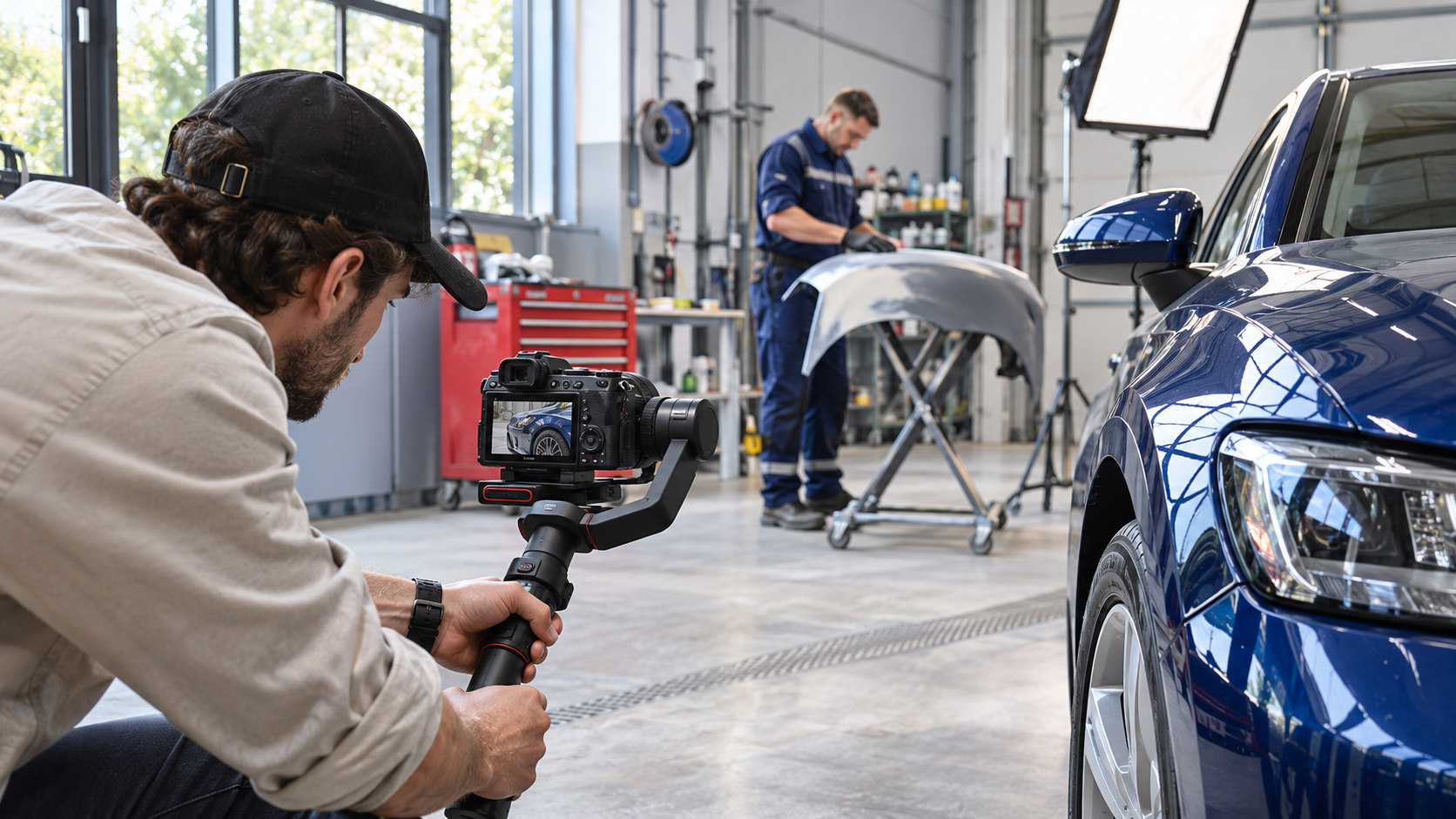
The speed ramp was filmed on location using a Panasonic S5. This example brought the real workshop into the content mix, with framing, vertical delivery and shot planning considered alongside the eventual edit.
A speed ramp depends on the relationship between the captured movement and the sequence being assembled. The production therefore needs shots that can connect, rather than a collection of attractive images with no shared intention. Planning the movement gives the edit a clearer foundation.
The official Panasonic S5 product guide provides a technical reference for the camera used here. In the case itself, the practical emphasis stays on composition, the delivery format and the footage required for a smooth result.
For comparable work, our brief would specify what viewers need to see, which angles establish the service and how the movement should connect. If filming takes place with a local production partner, that direction can travel through the script, shot list and reference material. The aim is to give the editor footage that supports the intended sequence and accurately represents the business.
The ANDER workflow: from idea to distribution
The LexCor content was published across TikTok, Instagram, Facebook and YouTube. Distribution belonged to the same workflow as ideas, scripts, filming and editing, because a finished video still needs a clear role in the business's communication.
At ANDER, we connect production decisions with the publishing context. The audience may encounter a short video without knowing the company, while someone already researching the service may need a clearer explanation or stronger evidence. A content plan should account for those different situations.
For a future campaign, the review can separate reach from audience growth, enquiries and commercial outcomes. Reach records how widely a piece travelled. Followers describe another response. Enquiries and sales need their own records and context. Treating these as distinct measures helps a team see which ideas build attention, which bring relevant interest and where the publishing plan needs further work.
Our content and creative support work connects planning with the assets a business needs to publish. In a service setting, that can begin with recurring customer questions, available project evidence and the people who can explain the work accurately.
The lesson from LexCor is practical: strategy, creative direction and execution become more useful when they refer to the same service story. That shared direction gives each format a reason to exist within the wider plan.
Build the next brief around the business
The starting point for a new brief is the business: the service to promote, the audience to reach, the available footage and the responsibilities around filming and approval. Those details help a team choose a manageable creative direction and a clear publishing objective.
We use the LexCor case to explain production choices, from AI-generated brand treatments to expert Reels and on-location footage. The right mix for another company depends on its message, evidence, resources and intended audience.
Share your video content brief with ANDER. Include the service or product, the people you want to reach and the material already available. Our team can use that context to discuss a practical starting point, the formats worth exploring and the questions that need answering before production begins.
A small, well-defined first production can establish the working process and reveal what additional footage or input is needed, giving the next stage a more informed foundation for planning and decisions.
Shape the next idea around your brand.
Tell us about your product, audience and content goals. ANDER can help connect strategy, production and editing in a clear working brief.